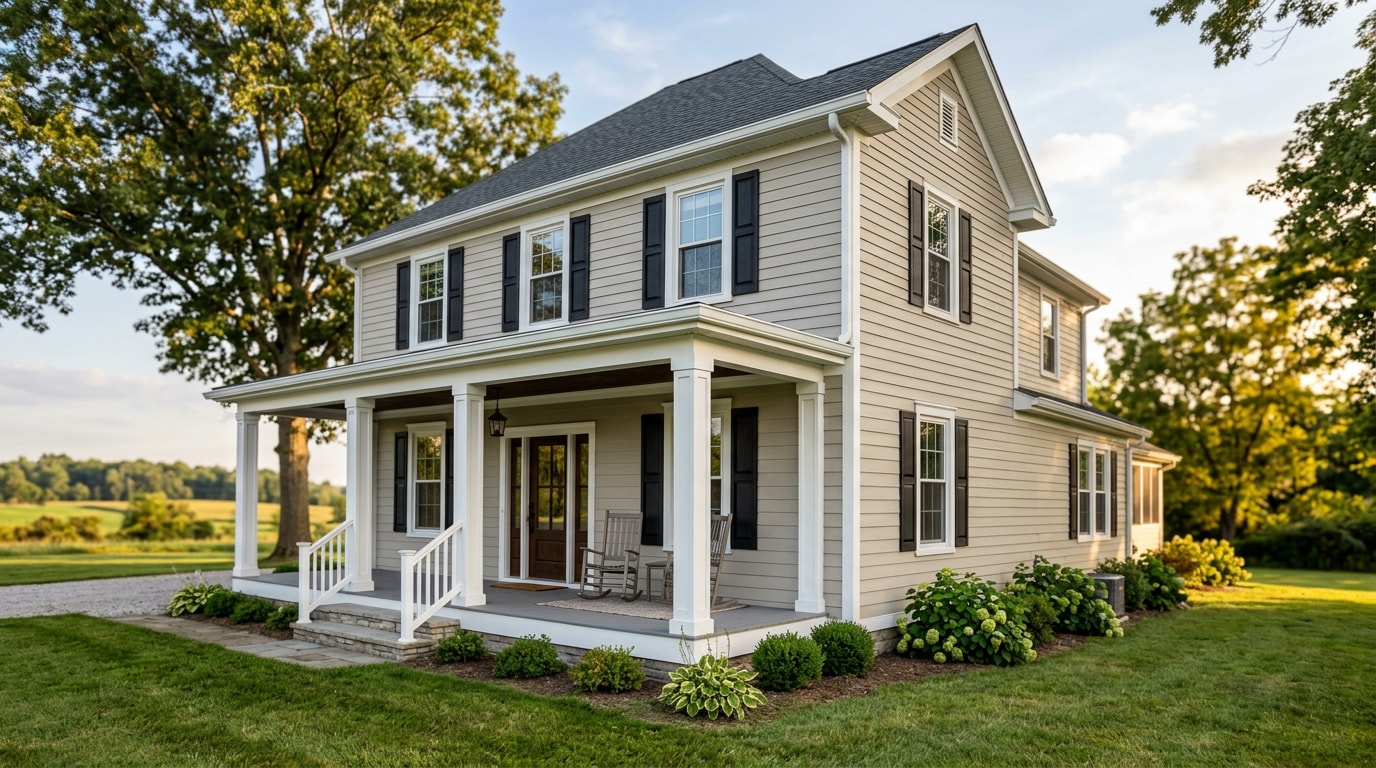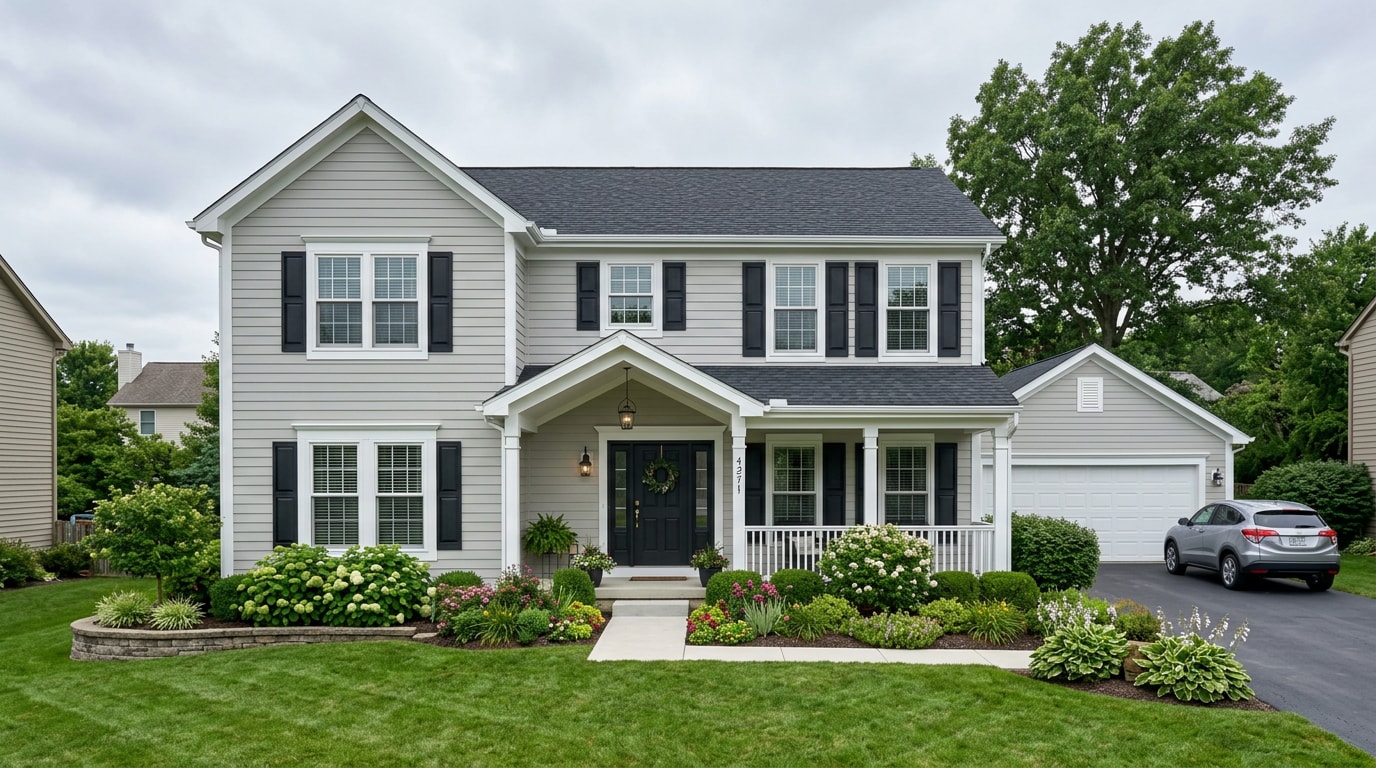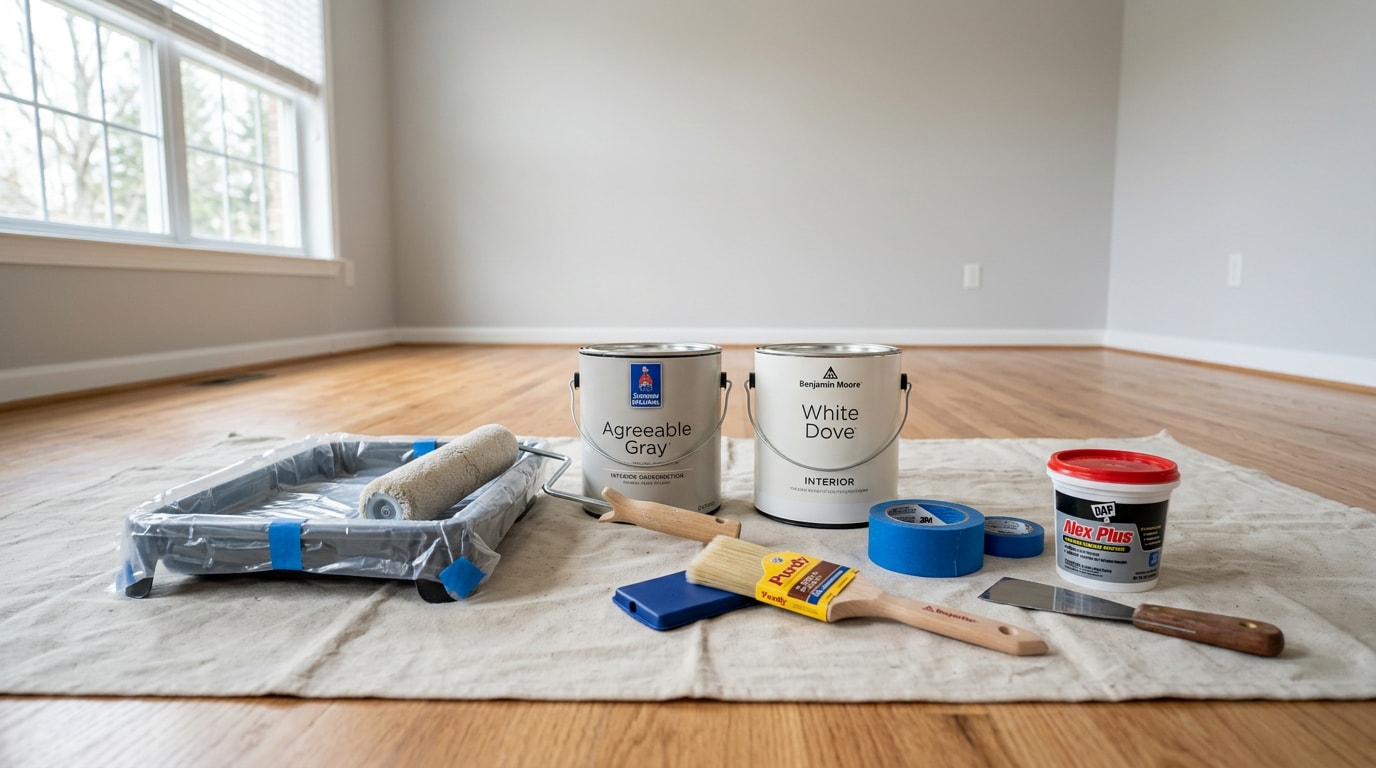
This house painting supplies list for New Albany, OH homeowners covers what a DIY repaint actually needs, from the gallons down to the sanding sponge. Load one cart, check out once, and start cutting in Saturday morning instead of driving back to the store twice. The cost tables below show what a one-room kit and a whole-house kit really run in 2026.
The Complete Painting Supplies Checklist (Copy This Before You Shop)
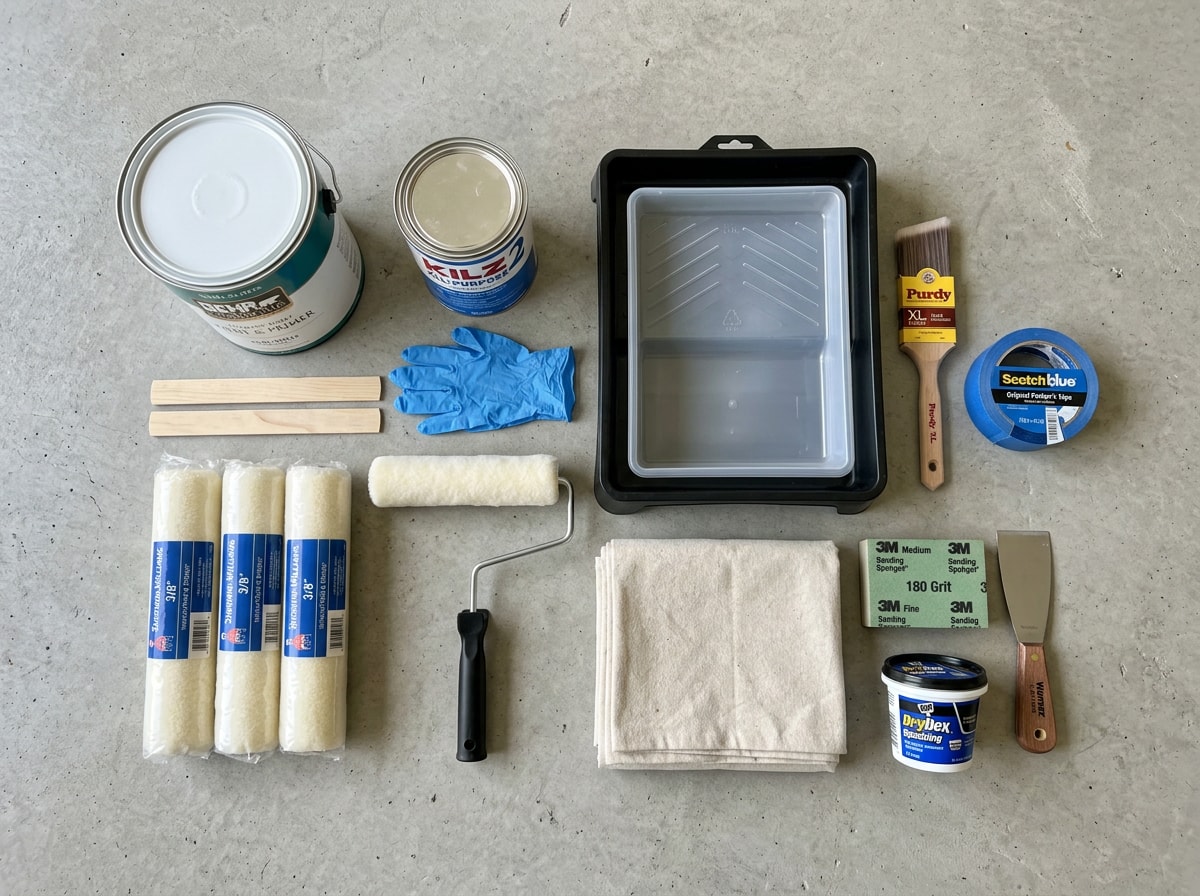
A full painting supply kit covers paint, primer, painter's tape, drop cloths, a tray with liners, a 9 inch roller frame, roller covers, a 2½ inch angled sash brush, an extension pole, spackle, a putty knife, sanding sponges, rags, stir sticks, a can opener, gloves, a ladder and trash bags.
Must have:
- Interior paint and primer, or a quality paint and primer in one
- 9" roller frame, two roller covers, tray and liners
- 2½" angled sash brush
- Painter's tape and drop cloths
- Spackle, putty knife, sanding sponge, damp rags
- Stir sticks, can opener, gloves, step ladder, trash bags
Nice to have: extension pole, 18" frame for long walls, mini roller, 5 gallon bucket and grid, raking work light, painter's hat.
For a same day run, most New Albany homeowners shop a paint store first for the gallons and tint, then a hardware store for the odds and ends, then a big box store for ladders and bulk drop cloths. If you would rather hand the whole thing off, here is what our painting crews cover across the New Albany area.
What the Kit Costs in 2026
| Item | One room kit | Whole house kit | Often already owned |
|---|---|---|---|
| Interior paint | $40 to $80 (1 to 2 gal) | $320 to $700 (8 to 12 gal) | No |
| Primer | $25 to $40 | $90 to $150 | No |
| Roller frame, covers, tray, liners | $25 to $35 | $55 to $85 | Frame |
| Angled sash brush | $12 to $22 | $25 to $45 | Sometimes |
| Painter's tape | $12 to $20 | $35 to $60 | No |
| Drop cloths | $20 to $35 | $50 to $90 | Usually |
| Spackle, knife, sanding sponges | $15 to $25 | $25 to $40 | Usually |
| Pole, stir sticks, gloves, bags | $20 to $30 | $30 to $45 | Pole |
| Estimated total | $170 to $285 | $630 to $1,215 | n/a |
Treat those as ballpark 2026 shelf prices. They shift with brand, paint line and whatever is on promotion that week.
Two Things We See on Almost Every New Albany Repaint
Our crews work New Albany subdivisions constantly, and two local details change the shopping list more than anything else.
Wall texture. Most homes built here in the last 25 years carry a light orange peel finish, not smooth drywall. That is a 3/8 inch nap job, not a 1/4 inch nap job, and it eats more paint per gallon than the label assumes.
Ceiling height. Plenty of newer New Albany builds run 9 or 10 foot ceilings on the first floor. A great room sized off an 8 foot assumption is how homeowners end up a gallon short on a Sunday. Measure the actual height before you buy.
Paint Selection
The paint is the one line item worth spending extra on. A cheap gallon costs you a third coat in labor, and labor is your whole weekend.
Interior Paint: Start With the Right Product
Pick interior paint by how the room gets used. A guest bedroom with north light asks very little of a finish. A mudroom off the garage, a kid's bath or a hallway that catches every backpack needs washability above all else.
| Surface | Product |
|---|---|
| Walls | Standard interior wall paint |
| Ceilings | Dedicated ceiling paint, flat |
| Trim, doors, railings | Trim paint, enamel or hybrid |
| Cabinets | Cabinet or door and trim enamel |
Primer deserves its own can in five situations: bare drywall, fresh patches, water or smoke stains, glossy or previously oil based surfaces, and dramatic color changes.
Outside those cases, a quality paint and primer in one over a sound painted wall is fine.
Brands matter less than matching the product to the surface. Any major line has a good, better and best tier, and the mid tier covers most homes. Our interior painting services page breaks down how we spec products room by room, and cabinet work uses a different enamel entirely.
Choosing the Right Sheen
Sheen controls two things that pull against each other: how well the finish hides flaws, and how well it survives a scrub sponge.
- Flat or matte: ceilings and low traffic bedrooms. Hides drywall imperfections best, cleans worst.
- Eggshell: living rooms, dining rooms, adult bedrooms. The usual default for walls.
- Satin or pearl: hallways, kids' rooms, laundry, family baths. Noticeably more scrubbable.
- Semi gloss: trim, doors, cabinets, full baths.
- Gloss: accent doors and railings. Shows every ripple.
Ohio weather nudges a few rooms up the scale. Bathrooms and kitchens handle real humidity, and entry doors and mudrooms take road salt, slush and grit from December through March. Satin or semi gloss in those spots will still wipe clean in year three.
How Much Paint to Buy
Most interior paints cover roughly 350 to 400 square feet per gallon on a smooth, primed surface.
Measure wall length times ceiling height, subtract about 20 sq ft per door and 15 sq ft per window, divide by 350, then double the result for two coats.
| Room (8 ft ceiling) | Wall area | Gallons, two coats |
|---|---|---|
| 10 x 10 | about 320 sq ft | 2 |
| 12 x 12 | about 384 sq ft | 2 |
| 14 x 16 | about 480 sq ft | 3 |
| 20 x 20 | about 640 sq ft | 4 |
That 350 sq ft figure is conservative on purpose. Knockdown texture, orange peel and popcorn ceilings all drink more paint than flat drywall. Plan on 10 to 20 percent less coverage per gallon on texture, and check the spread rate printed on the manufacturer's technical data sheet for the exact product in your hand. Always keep a quart in reserve for touch ups.
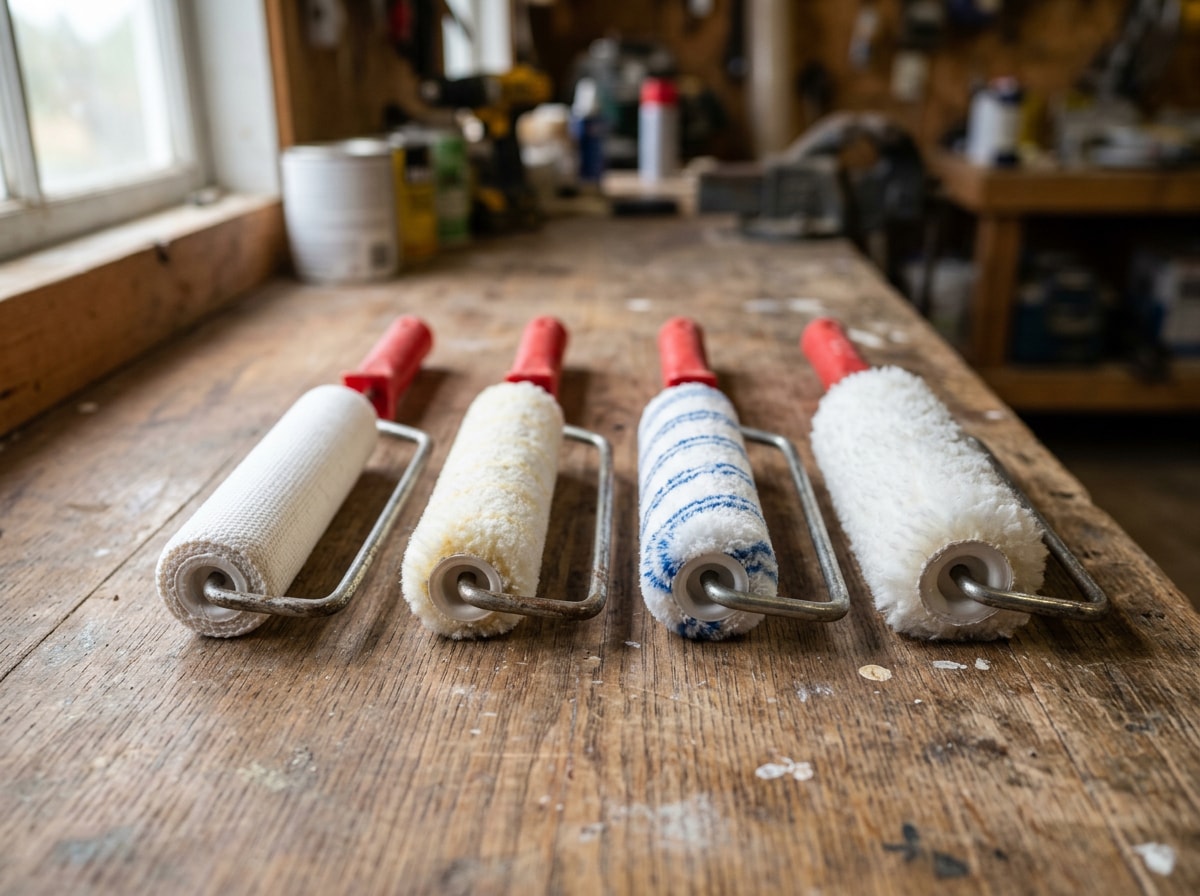
Rollers and Roller Covers
The roller lays down roughly 90 percent of your square footage. Nap length, not price, decides whether the wall ends up smooth or stippled.
| Roller nap | Best surface |
|---|---|
| 1/4" | Smooth new drywall, doors, cabinets |
| 3/8" | Light orange peel, most finished walls |
| 1/2" | Knockdown texture, light stucco |
| 3/4" and up | Textured ceilings, brick, block, rough stucco |
Buy two covers per color. One to work with, one as backup when the first picks up lint.
A 9" frame handles almost everything. An 18" frame pays off on long, uninterrupted walls, and a 4" mini roller gets behind toilets and into closets.
An extension pole in the 2 to 4 foot range saves your shoulders on 8 foot walls and keeps you off a ladder for ceilings. A tray with disposable liners works for one room. For a whole floor, a 5 gallon bucket and grid holds more and spills less.
If you do end up on a ladder for a stairwell or a vaulted ceiling, set it at the right angle and keep three points of contact. OSHA's ladder safety guidance is written for job sites, and the setup rules apply just as well at home.
Paint Brushes: Use an Angled Brush for Cutting In
One brush does most of the work: a 2½" angled sash brush. The angled tip rides a line, so you get a clean edge without taping every surface in the room.
You will use it along ceiling lines, inside corners, around outlets and switch plates, down trim and baseboards, and around built ins. Add a 1" or 1½" detail brush for doorknob escutcheons, light fixtures and window muntins.
Match bristles to the paint. Synthetic nylon or polyester bristles for latex and water based products, natural bristle only for oil based paints and varnishes. Natural bristles swell in water and go limp.
Load only the bottom third of the brush and tap off the excess instead of dragging it on the rim. An overloaded brush drips down your wrist and floods the line you are trying to keep straight.
Painter's Tape
Buy quality painter's tape, not masking tape. The cheap stuff bleeds and leaves adhesive behind.
Standard blue is fine for 14 day removal. Delicate surface tape suits fresh paint and wallpaper. Keep 1.5" and 2" widths on hand.
Pull the tape while the paint is still slightly soft, at a 45 degree angle, back over itself. Fully cured paint tears at the edge.
Taping wins on window frames, built ins and crisp two tone walls. On a long ceiling line, a steady hand with a sash brush is usually faster than taping it.
Drop Cloths
Canvas is the right call on hardwood. It absorbs drips, lies flat and does not turn slick underfoot.
Plastic sheeting is cheap but slides and becomes a fall hazard on finished floors. Save it for draping furniture.
Paper backed poly splits the difference and grips carpet well. A typical 12x12 bedroom needs one 9x12 canvas drop cloth plus a roll of plastic for the furniture you pushed to the middle.
Prep Supplies
Spackle, sandpaper and rags are the cheapest items on your whole list. They are also the ones that separate a repaint that looks professional from one that looks like a weekend project with a nice color.
Wall Repair: Spackle, Putty Knife and Sandpaper
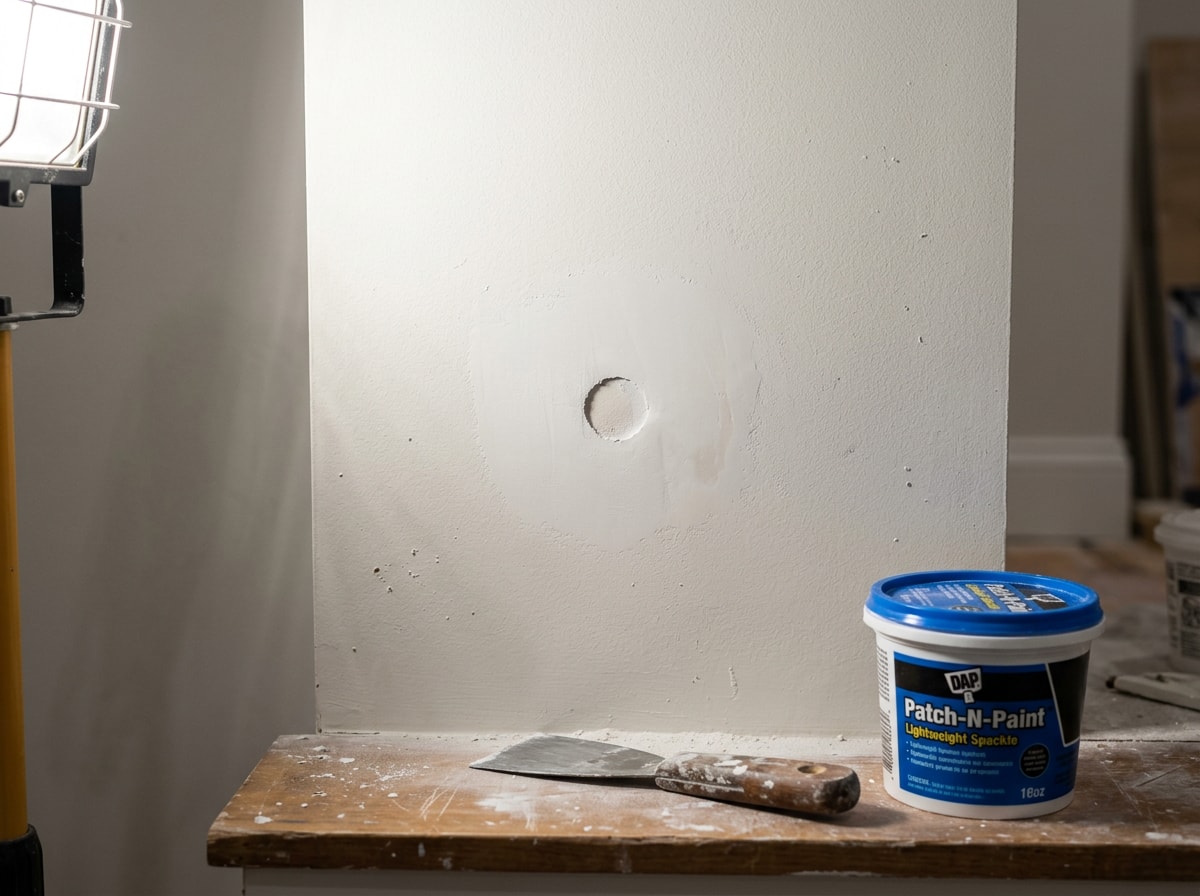
Work the walls under raking light. Set a work lamp close to the surface at a sharp angle and every dent, nail pop and roller ridge shows up. Circle them with a pencil.
Fill small holes with lightweight spackle using a flexible 1½" to 3" putty knife, slightly overfilling. Let it dry, knock it down with a 150 to 220 grit sanding sponge, then wipe with a damp rag so dust does not ruin your topcoat.
Anything bigger than about an inch needs a drywall patch, not spackle. That is where most DIY repaints stall out, and it is why we keep drywall repair on the same truck as the paint.
Use 80 to 120 grit to dull glossy trim, and a stiff paint scraper, not a putty knife, for loose or peeling exterior paint.
One caveat for older housing stock: plenty of homes around Plain Township and the Columbus side predate 1978. Sanding or scraping those surfaces can disturb lead paint, which triggers specific containment and cleanup steps under the federal Lead Renovation, Repair and Painting rule. Test first.
Cleaning and Cleanup
Walls need to be clean before they will hold paint. Dust everything with a dry microfiber, then hit kitchen walls and bath ceilings with a degreaser or a TSP substitute and rinse. Paint will not bond to cooking film.
For cleanup, keep rags, a scrub bucket and a brush comb handy. Latex washes out with warm water.
Leftover paint and rinse water do not belong down a drain or in the curbside bin. In Franklin County, SWACO accepts household hazardous waste at its drop off facility, and latex paint is handled separately for a small per gallon fee because it is not classified as hazardous. Drying out the cans with a hardener and tossing them in the regular trash is the cheaper route.
What You Can Skip
Not everything in the paint aisle earns its spot in the cart.
- Paint sprayer rental for one room. Masking a single bedroom takes longer than rolling it.
- Bargain bin roller covers. They shed lint into the finish on coat one.
- Tape on every single edge. Cut in with the sash brush instead and save the hour.
- A second color of primer. Tinted primer helps on deep color changes, but a gray tint covers most of them.
- Premium paint on a ceiling. Flat ceiling paint is one of the few places the budget tier performs fine.
When DIY Stops Making Sense
The supply list is cheap. The time is not.
Hand it off when you are looking at stairwells and two story foyers, heavy peeling on exterior siding, cabinets that need a sprayed finish, or pre 1978 surfaces with suspected lead. Exterior work in particular comes with prep that most homeowners are not equipped for, including the caulking sequence we walk through in our guide to the best caulk for exterior painting in New Albany.
See how finished work holds up in our project gallery, browse all of our painting services, or get a free estimate and we will price the room against what the supply run would cost you.
FAQ
What supplies are needed to paint a room?
At minimum: paint, primer if needed, a 9" roller frame with covers, a tray and liners, a 2½" angled sash brush, painter's tape, a drop cloth, spackle, a putty knife, a sanding sponge, rags and a stir stick. The full checklist above adds the rest.
Do I need primer before painting?
Prime in five cases: bare drywall, fresh patches, water or smoke stains, glossy or oil based surfaces, and a major color change such as deep red going to white. Over sound painted walls in a similar color, paint and primer in one is enough.
How much paint do I need for a 12x12 room?
Two gallons for the walls. A 12x12 room with 8 foot ceilings has about 384 sq ft of wall. Subtract a door and a window and you are near 350 sq ft, or 700 sq ft across two coats. Taller ceilings or heavy texture push you to three.
In what order should I paint a room?
Ceiling first, then walls, then trim and doors last. Cut in each surface with your angled brush before rolling it so wet edges blend. Working top down means any drips land on a surface you have not finished yet. The same logic applies to exterior repaints.
What roller nap should I use?
Use 3/8 inch for most finished walls in New Albany homes, 1/4 inch for smooth drywall and doors, 1/2 inch for knockdown texture, and 3/4 inch or more for ceilings, brick and block.
How many coats of paint do I need?
Two, in almost every case. One coat only works when you are repainting the exact same color over a clean, sound surface. Deep colors and bare patches usually need two coats over primer.
Is it cheaper to paint a room yourself?
On materials alone, yes. A one room DIY kit runs roughly $170 to $285 in 2026, and most of those tools carry over to the next room. The math tips toward hiring out when ceilings are high, walls need real repair, or you would lose multiple weekends to it.
What tools do professional painters use that homeowners skip?
A 5 gallon bucket with a grid instead of a tray, a raking work light for finding wall defects, a brush comb, and a 12 inch or 18 inch roller frame on long walls. All four are inexpensive and all four speed the job up.
How do I dispose of leftover paint in Franklin County?
Dry out latex paint with a commercial hardener, cat litter or sawdust, then put the solidified can in the regular trash. Wet paint and oil based products go to the SWACO household hazardous waste drop off in Columbus.
---
About this guide: written by the field crew at PKC Custom Painting, who prep and repaint interiors and exteriors across New Albany, Westerville and Gahanna. The texture, ceiling height and sheen notes above come from the homes we work in week to week. Questions about your own project? Contact us and we will answer them straight.